flowchart TB
    subgraph AI["🐯 Artificial Intelligence"]
        direction TB
        subgraph ML["🧠 Machine Learning"]
            direction TB
            subgraph DL["⚡ Deep Learning"]
                Neural["Neural Networks<br/>CNNs, RNNs, Transformers"]
            end
            Traditional["Traditional ML<br/>Decision Trees, SVM, K-Means"]
        end
        RuleBased["Rule-Based Systems<br/>Expert Systems, Planning"]
    end

    style AI fill:#e3f2fd,stroke:#1976d2,stroke-width:3px
    style ML fill:#e8f5e9,stroke:#388e3c,stroke-width:2px
    style DL fill:#fff3e0,stroke:#f57c00,stroke-width:2px
Welcome To The World Of AI & ML
The Awakening Robotic Tiger
In the hush of a predawn jungle, something stirs. A pair of gleaming eyes flicker open amidst the foliage. The creature rises on mechanical limbs, its striped metal flank reflecting the faint glow of dawn. The robotic tiger has awakened. It pauses, ears attuned to the forest’s whispers, and takes its first cautious steps into a world brimming with unknowns. Each movement is a blend of raw power and careful calculation—instinct meshed with algorithm. The other animals watch from a distance, uncertain whether to fear this new predator or marvel at it. In this moment, the jungle holds its breath, witnessing the emergence of a new kind of creature that will learn, adapt, and perhaps even thrive among them. This vivid scene is a metaphor for the dawn of artificial intelligence (AI) in our world. Like the robotic tiger stepping into the wild, AI systems are venturing into nearly every aspect of our lives. They are powerful yet untested, capable of remarkable feats yet continuously learning from their surroundings. In this book, the AI Jungle is our immersive setting, where each creature and landscape element represents an aspect of AI or Machine Learning (ML). Our journey begins with the awakening of the robotic tiger—a symbol of AI’s introduction and burgeoning potential. Through this tale, we will explore what AI and ML are, why they matter, how they came to be, and how they learn, all in an accessible way that invites even the most non-technical reader to venture deeper into the jungle.
As our robotic tiger roams its new habitat, its presence is felt throughout the jungle. In much the same way, AI and ML are rippling across industries and daily life, leaving no corner of the modern world untouched. Here are a few reasons why these technologies have become so important (for both the jungle and us humans):
Rapid Technological Growth
Over the past decade, AI technology has progressed faster than many anticipated. Smarter algorithms, more powerful computing hardware, and vast troves of data have accelerated AI from a curious experiment to a transformative force. The robotic tiger, once just a concept in a scientist’s mind, is now very real and growing stronger. Likewise, AI can now solve problems once deemed too complex for machines—ranging from understanding human language to recognizing images and patterns that elude ordinary programs.
Impact on Daily Life
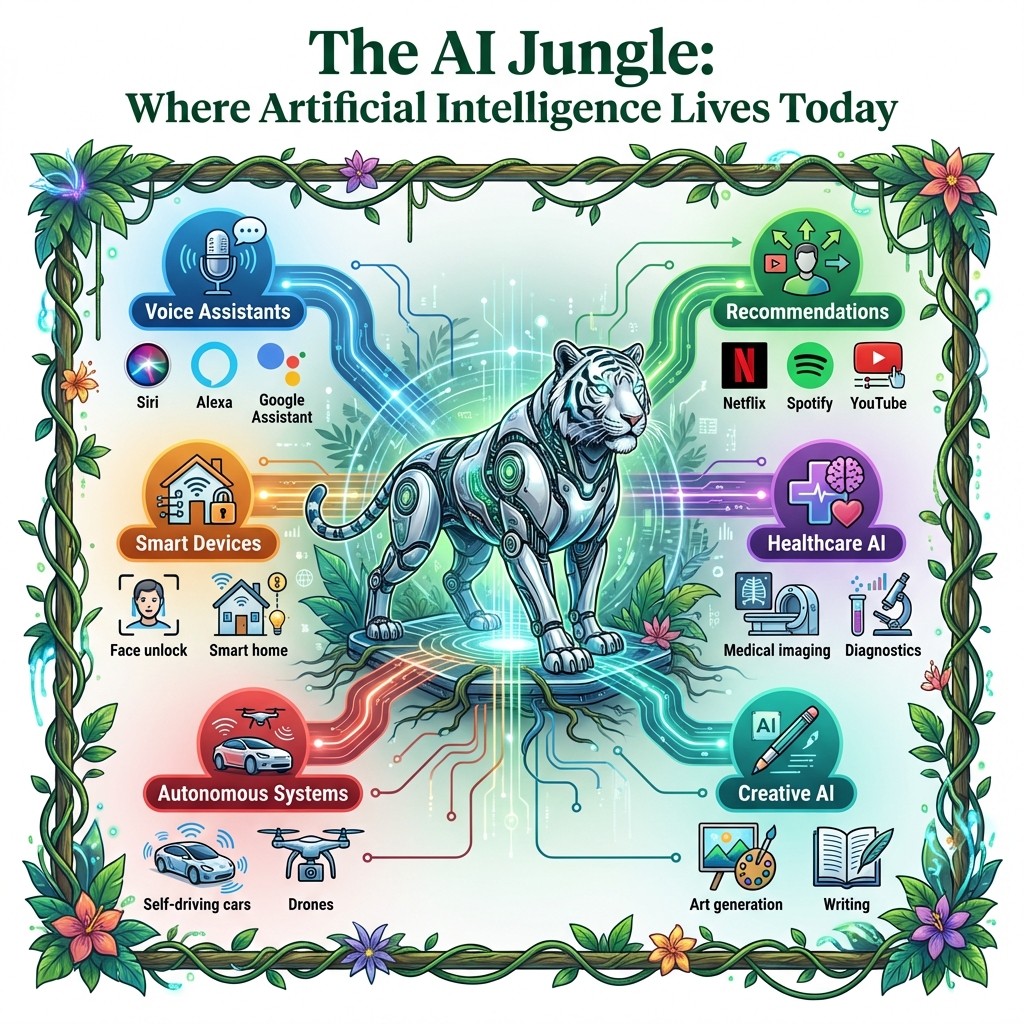
AI systems are quietly working behind the scenes in everyday applications, much like an unseen tiger influencing the balance of the jungle. Voice assistants on our phones and smart speakers (think of Siri or Alexa) can interpret speech and respond with helpful information. Streaming services learn your tastes to suggest the next show or song you’ll love. Email apps use ML to filter out spam, catching pesky unwanted messages before you ever see them. When you unlock your smartphone with your face, a deep learning algorithm recognizes you in a split second. AI helps cars navigate streets, suggests the best routes on maps, and even creates art or writes stories when asked. In short, this technology touches our lives in countless small ways each day, often without us realizing it’s there—just as the tiger’s subtle movements keep the jungle ecosystem in balance.
Not Just for Scientists
You don’t have to be an AI researcher to feel its benefits. Professionals in fields like healthcare, finance, agriculture, and marketing are increasingly using AI tools to work smarter. Doctors employ AI to help detect diseases in medical images with greater accuracy, farmers use smart sensors and ML to improve crop yields, and marketers rely on AI to understand customer behavior. Just as every creature in the jungle, from the wisest owl to the tiniest bird, must learn to live in a world with the tiger, people across all professions are learning to collaborate with AI. These technologies are becoming accessible to everyone, not just PhDs in labs. In fact, many user-friendly AI applications allow even beginners to experiment—imagine park rangers guiding villagers to understand and befriend the tiger rather than fear it. This broad adoption is driving innovation and problem-solving in areas that were previously untouched by advanced tech.
In essence, AI and ML are important because they offer new ways to solve problems, enhance our daily experiences, and expand what’s possible. The roar of the robotic tiger is being heard across the globe, signaling a new era of possibility and progress.
A Brief (And Lively) History of AI
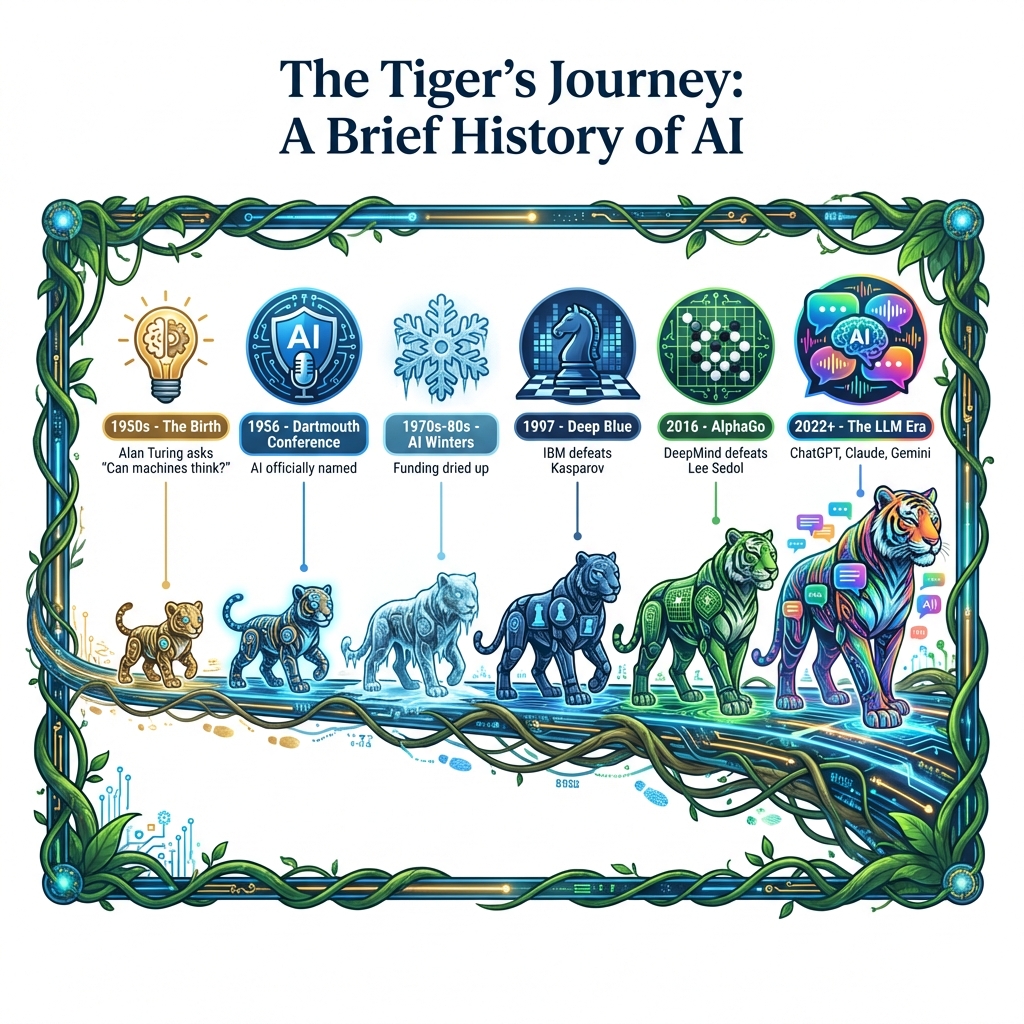
Even the mightiest tiger has humble beginnings, and so does the story of AI. The journey of artificial intelligence has been a wild ride—full of early triumphs, long winters of doubt, and roaring comebacks. Let’s travel back in time through the jungle of AI’s past:
Early Days (1950s–1960s)
In the mid-20th century, pioneers of computing began to wonder if machines could learn to “think.” Visionaries like Alan Turing posed groundbreaking questions—for example, “Can machines think?”—which echoed like the first distant roar of a predator in the jungle. The field of AI was officially born in 1956 at a now-legendary academic workshop, and enthusiasm ran high. Early programs showed promise: some could play a decent game of checkers or prove basic mathematical theorems. It was as if a cub had been born—small and limited, but hinting at great potential. However, the computing hardware of the time was primitive by today’s standards. These early AI systems lacked the memory and processing speed to grow into the powerful tiger everyone envisioned. Still, the concept was out in the wild, and researchers could sense they were onto something big, even if the full-grown reality was still years away.
The AI Winters (1970s–1980s)
After the initial excitement, progress in AI slowed to a crawl, entering a period aptly dubbed the “AI winters.” Imagine our young tiger wandering into a harsh season where food is scarce and growth is stalled. During the 1970s and 1980s, lofty expectations met cold reality. Many projects over-promised and under-delivered; funding dried up, and public interest waned. The jungle grew quiet—no new roars were heard for some time. For AI researchers, these were tough years, like a dormant winter when the idea of a truly intelligent machine felt frozen in uncertainty. Yet, beneath the frost of disappointment, a few dedicated explorers kept the embers of AI alive, continuing their work quietly until conditions were right for a resurgence.
Modern Resurgence (1990s–Present)
Spring eventually returned to the AI jungle. From the 1990s onward, advances in computing power and an explosion of available data led to a dramatic resurgence in AI capabilities. The robotic tiger had grown up and found its strength. In 1997, IBM’s Deep Blue supercomputer stunned the world by defeating reigning chess champion Garry Kasparov — a symbolic roar that signaled the tiger was back on the prowl. Fast forward to 2016, and DeepMind’s AlphaGo program defeated Go master Lee Sedol, a feat once thought decades away due to Go’s enormous complexity. That was a thunderous roar, heard around the globe, announcing that modern AI can take on and conquer incredibly complex tasks.
These high-profile victories were just the beginning. In the 2010s and 2020s, AI left the research labs and started appearing everywhere in daily life. Smartphones became smart largely thanks to AI-driven features. Cars began to inch closer to driving themselves. Language models learned to write human-like text, and image generators created artwork from simple prompts. AI assistants grew more helpful, capable of engaging in human-like conversations. The once-quiet jungle is now teeming with activity – AI is everywhere, and it’s advancing faster than ever. The robotic tiger, representing AI, is no longer a solitary curiosity; it’s part of a growing pride influencing the entire ecosystem. And while we’ve seen amazing achievements, the story of AI is far from over – in fact, it’s just getting started.
Understanding AI, Machine Learning, and Deep Learning
By now, you might be wondering: What exactly are AI and Machine Learning, and where does “Deep Learning” fit in? These terms can seem like a tangled jungle of jargon, but they’re easier to understand than they appear. Let’s break it down in plain language (with a little help from our tiger metaphor):
Artificial Intelligence (AI)
Artificial Intelligence is the broadest term — it’s like the entire jungle of intelligent behaviors we want machines to exhibit. AI refers to any technique that enables computers to mimic human-like intelligence, performing tasks that typically require human thinking. This can include learning, problem-solving, recognizing patterns, making decisions, and more. Not all AI systems learn from data; some early AIs were explicitly programmed with fixed rules (imagine a tiger that only knows the paths its creator mapped out, and never strays). Whether it’s a chess-playing program or a voice assistant answering your questions, if a machine is doing something smart — something we’d normally expect a person to do — it qualifies as AI. In our metaphor, AI is the idea of the robotic tiger itself — the grand vision of creating a machine that can act intelligently in its environment.
Machine Learning (ML)
Machine Learning is a subset of AI, and it’s all about learning from experience. Rather than being manually programmed for every task, an ML system is designed to analyze large amounts of data, learn from those examples, and improve over time. This is akin to how our robotic tiger learns the ways of the jungle on its own: instead of a human guiding each step, the tiger observes patterns (like where prey gather or how to stalk effectively) and gets better through trial and error. When you hear about an email filter that becomes more accurate after processing thousands of emails, or a music app that gets better at guessing songs you’ll love based on your listening habits, that’s ML in action. The system finds patterns in data and uses those patterns to make predictions or decisions. In short, if AI is the goal of making machines smart, ML is one of the primary means to achieve that goal — by empowering machines to learn from data. Our tiger’s ability to adapt to the jungle (rather than just follow a preset script) captures the spirit of ML.
Deep Learning (DL)
Deep Learning is a specialized subfield of machine learning, inspired by the structure of the human brain. If ML is about learning from data, deep learning does so using multi-layered networks of mathematical “neurons” that can automatically discover intricate patterns. Think of it as the tiger’s heightened senses and instincts. A tiger relies on a combination of sight, sound, and smell; similarly, a deep learning model has multiple layers that each detect different features (one layer might pick up simple shapes or sounds, the next layer combines those into more complex concepts, and so on). This layered approach allows deep learning systems to tackle incredibly complex tasks — like recognizing faces in photos, understanding spoken language, or translating between languages — often with greater accuracy than previous techniques. Deep learning has driven many of AI’s most impressive recent breakthroughs because these deep neural networks excel at handling the complexity and volume of data in modern problems. In our story, deep learning is represented by the tiger’s keen instincts working together: individually simple inputs (a rustle in the leaves, a flash of movement) are processed through layers of perception to become a coherent understanding of the world (“there’s prey hiding in that bush”). Deep learning models do require a lot of data and computing power — our tiger needs to experience many events in the jungle and have a strong inner circuitry to fine-tune its hunting prowess — but when they have it, they can achieve remarkable results.
NoteThe AI Hierarchy at a Glance
| Term | What It Is | Tiger Analogy |
|---|---|---|
| AI | Broad field of machine intelligence | The idea of a smart robotic tiger |
| ML | Learning from data, not rules | Tiger learns by exploring the jungle |
| DL | Multi-layered neural networks | Tiger’s layered instincts working together |
Understanding this hierarchy will help you make sense of the buzzwords and appreciate how they relate to each other in the world of AI
AI As A Robotic Tiger Learning To Hunt (Analogy)
Overview
Imagine an advanced robotics lab tasked with creating a life-like AI-powered tiger—one that roams a controlled environment, detects prey, and adapts its strategies. While this premise seems straight out of science fiction, it mirrors the core stages of AI development: collecting data, building models, training, validation, and final deployment. In our analogy, the robotic tiger’s journey brings these AI stages to life: sensing (data), understanding (algorithms), learning (training), improving (feedback), and acting (deployment). Below, we break down each stage of AI development in terms of the tiger’s creation and learning process.
flowchart LR
    D["📊 Data<br/>(Tiger's DNA)"] --> A["🧬 Algorithm<br/>(Cognitive Blueprint)"]
    A --> T["🏋️ Training<br/>(Practice Hunts)"]
    T --> F["🔄 Feedback<br/>(Learn from Mistakes)"]
    F --> V["✅ Validation<br/>(Test in Wild)"]
    V --> Dep["🚀 Deployment<br/>(Release Tiger)"]
    F -.->|iterate| T

    style D fill:#e3f2fd,stroke:#1976d2,color:#000
    style A fill:#e8f5e9,stroke:#388e3c,color:#000
    style T fill:#fff3e0,stroke:#f57c00,color:#000
    style F fill:#fce4ec,stroke:#c2185b,color:#000
    style V fill:#f3e5f5,stroke:#7b1fa2,color:#000
    style Dep fill:#e0f2f1,stroke:#00796b,color:#000
1. Data = The Tiger’s “DNA” and Sensory Inputs
A real tiger is born with instincts encoded in its DNA, sharpened through interaction. For our robotic tiger, data serves this role.
- Biological Inspiration: Just as a real tiger is born with instincts encoded in its DNA, our robotic tiger’s capabilities start with its data. Researchers gather extensive data on how tigers move, react, and hunt—analyzing gait, speed, and behavior. This bio-inspired approach is common in robotics; engineers often borrow from animal designs to build fast, agile robots. By studying real tigers’ movement and predatory behavior, the team encodes foundational “instincts” into the AI’s data.
- Sensors: To replicate a tiger’s keen perception, the robotic tiger is equipped with an array of sensors. High-resolution cameras provide vision, thermal imaging allows it to “see” in the dark by detecting heat signatures, and directional microphones serve as its ears. These sensors form the tiger’s artificial senses, feeding it continuous streams of data about the environment. (In nature, tigers have superb night vision and hearing; in the lab, infrared cameras and thermal sensors similarly let the robot operate in low-light conditions.) High-quality sensory data is crucial – every sight, sound, and heat trace becomes input to the AI’s “brain.”
- Parallel: In the wild, a tiger cub’s genetic instincts and early experiences shape its hunting ability; for our AI tiger, data plays that genetic role. The quality of data is paramount. “Data is the DNA of artificial intelligence,” as one analyst put it. If the robot is trained on poor or biased data, its instincts will be flawed – a classic “garbage in, garbage out” scenario. Conversely, rich and diverse data leads to robust instincts. Just as a tiger with poor eyesight would struggle to hunt, an AI given low-quality or incomplete data will perform poorly. In short, good data is foundational: the better the “DNA” we give our robotic tiger, the better its base instincts and perceptual abilities.
2. Algorithms = Behavioral Blueprint
Once the data (the tiger’s “DNA”) is in place, engineers craft the algorithms that serve as the tiger’s cognitive blueprint. If data is the raw instinct, algorithms are the learned logic and coordination guiding those instincts.
- Control & Response: The robotic tiger’s control algorithms coordinate its limbs and interpret sensory data to make decisions. For example, when the tiger’s camera detects a moving object (potential prey), the algorithms must recognize the pattern – Is it prey? How fast is it moving? – and then command the robot’s motors to pounce or pursue. This involves computer vision, motion planning, and robotics control theory encoded into the AI’s software. Researchers design these algorithms as a blueprint for behavior, much like an animal’s brain that processes perceptions into actions. In practice, this might mean using a convolutional neural network (CNN) to interpret the tiger’s camera feed and identify prey versus empty foliage. In one study, giving a robot a specialized CNN (modeled after an animal’s visual cortex) plus a fast-reacting sensor was key to enabling it to track and hunt a target in real time. The algorithms ensure the robotic tiger can coordinate its sensory inputs with motor outputs – effectively linking “eyes” to “muscles” in the machine.
- Parallel: Without robust logic, even the best sensors can’t guide effective decisions. A tiger’s natural instincts are useless without its brain’s decision-making ability. Similarly, our robot’s cameras and thermal sensors would be wasted unless the AI’s software logic makes sense of the data and chooses wise actions. The algorithms act as the behavioral blueprint – if they are poorly designed, the robotic tiger might misidentify a gust of wind as prey or stumble instead of sprint. On the other hand, well-crafted algorithms (e.g. for balancing, target tracking, and path-planning) enable graceful, lifelike movements. Think of this as the “mind” of the tiger: it needs to be as sharp as the senses. By programming patterns of action (stalk, chase, leap) and reaction (startle responses, avoidance of obstacles), engineers imbue the robot with a logical framework to execute its hunts. In summary, data gives our AI tiger potential instincts, but algorithms give it intelligence and coordination – a rulebook for turning inputs into purposeful action.
3. Training = Practice Hunts
Before unleashing the robotic tiger into the wild (even a controlled wild), the engineers train it extensively through practice hunts. This training phase is akin to a young tiger cub play-hunting with siblings or stalking something harmless – safe practice to hone its skills.
- Virtual Simulation: Initially, the tiger is trained in simulated environments – think of these as virtual jungles or enclosed arenas generated in software. In simulation, the AI can practice hunting without real-world consequences. Engineers construct lifelike digital jungles with dynamic prey (perhaps virtual gazelles or robots) and let the AI tiger roam and attempt hunts. Each scenario can be reset and repeated, allowing thousands of trials. Crucially, simulation provides a safe and controllable training ground. For example, Boston Dynamics used this approach for their quadruped robots: they ran over a million simulated trials with varied terrains and obstacles to teach the robot how to navigate and stay balanced. Our robotic tiger similarly goes through practice hunts in VR, learning how to approach prey, when to chase, and how to navigate terrain, all without risking expensive hardware in the real world.
- Trial & Error: This training is driven by trial and error. In the beginning, the AI tiger will make plenty of mistakes – overshooting its jumps, misjudging the prey’s escape path, or falling for decoys. Each mistake is a learning opportunity. The algorithms (especially if using reinforcement learning) adjust internal parameters based on success or failure outcomes. Engineers often employ reinforcement learning where the AI “optimizes its strategy through trial-and-error experience in a simulator”. Concretely, the robot is given a goal (e.g. catch the moving target) and a reward system: successes (captures) earn reward points and failures (losing the target or stumbling) incur penalties. Over countless repetitions, the AI modifies its behavior to maximize rewards – much like a tiger cub refining its pounce timing with each attempt. This iterative loop continues until the robotic tiger’s performance in simulation becomes consistently competent. We can see dramatic improvement during training: initially clumsy, the AI tiger gradually develops smooth stalking, rapid reaction times, and tactical approaches to corner prey. By the end of this phase, the robotic predator has essentially completed “boot camp” – it has practiced enough in artificial jungles to handle real-world variability.
4. Feedback & Reinforcement
Learning doesn’t stop once the initial training is done. The feedback loop is a critical part of the AI tiger’s development, mirroring how real tigers learn from each hunt. In this stage, every outcome feeds back into improving the model’s performance – this is essentially the refinement of instincts through reinforcement.
- Rewards: Each successful hunt (in training or later in the field) acts as positive reinforcement. In AI terms, the system might increase the weight on actions that led to success. For instance, if the robotic tiger successfully ambushed a decoy prey after moving quietly behind cover, the AI notes this strategy as effective. The algorithms then bias future decisions towards similar action sequences in similar contexts. This process implements the classic reinforcement learning principle: behaviors leading to rewards are strengthened. Engineers explicitly design reward functions for the AI – for example, +10 points for a capture, -1 point for every second of delay, -50 for losing sight of the target. By optimizing these rewards, the robotic tiger hones strategies that yield the highest “score” (which corresponds to real success in hunts). Over time, the AI accumulates an experience bank of what works and what doesn’t, becoming more adept with each iteration
- Penalties: Likewise, failures or missteps provide crucial feedback. If the tiger pounces too early and the prey escapes, the system registers that as a negative outcome. The algorithms adjust, effectively learning from the mistake. Developers might observe failures and explicitly tweak the model or add training data to correct behavior. In practice, any time the robot tiger “fails” – say it tumbles while running on wet terrain or gets outmaneuvered by the target – engineers incorporate that feedback. They can recreate the failure scenario in simulation and retrain the AI to handle it better. This adaptive loop was highlighted in Boston Dynamics’ process: when their robot encountered a novel situation (like slipping), they reproduced it in sim and retrained the controller, so the robot became robust to it in future. In our analogy, this is like a tiger learning after a failed hunt – if the prey consistently bolts left when approached from upwind, the tiger learns to approach from a different angle next time. Continuous feedback ensures the AI tiger doesn’t just rely on its initial training, but actively improves with experience. The result is an ever-smarter hunter: over many trials, the robotic tiger refines its movements, reaction speed, and tactical decisions, approaching an expert level of performance. This reinforcement phase highlights a core truth of AI – it thrives on feedback loops, much as living creatures do when learning new skills.
5. Validation & Deployment
After rigorous training and iterative improvements, the robotic tiger is finally evaluated in real-world conditions – the validation phase – and then released for deployment. This stage is about making sure the tiger can actually perform in the unpredictable, messy reality outside the lab, and fine-tuning it as needed.
- Stress Tests: Before declaring the AI tiger ready, engineers put it through stress tests in varied environments. The robot is moved from virtual simulations to physical testing grounds that mimic the wild: uneven terrain, obstacles like bushes or rocks, moving targets for prey, and random noise or distractions. The goal is to validate that the tiger’s learned behaviors translate to the real world. Often, robotics teams will test performance across a spectrum of conditions – different weather (rain, dusk lighting), different terrains (mud, sand, hills), and unexpected events (a sudden loud sound or a second prey appearing). At Boston Dynamics, for example, they run their robots through hundreds of scenarios in simulation and then a battery of on-hardware tests to ensure reliability. Our AI tiger undergoes a similar gauntlet: Can it chase a target up a slippery slope? Does its thermal vision still identify prey in dense foliage? How does it react if its prey zigzags or if the GPS signal is lost? These trials are essentially an examination of the AI in the real world. Any shortcomings discovered (e.g. the tiger struggles on very rocky ground) are noted for refinement. The validation ensures that the robotic predator can handle the “noise” and variability of life outside the lab.
- Final Tuning: Final Tuning: Based on the results of field tests, engineers perform final tuning. This might involve updating the model with new data collected during testing, adjusting parameters, or adding new training scenarios to cover edge cases. Crucially, deployment is not the end of learning – it’s an ongoing process. Once the tiger is operational in its intended environment, it will continue to collect data and feedback. Developers often monitor deployed AI systems and periodically update them. In our analogy, after deployment the robotic tiger might encounter truly novel situations (say, a new type of obstacle or a different species of target) and its performance is tracked. Using these real-world experiences, the team can further refine the tiger’s software. This is akin to how a wild tiger, over years of hunting, becomes wiser and adapts to changes in its ecosystem. For AI, this may manifest as software updates or model retraining with fresh data. The deployment stage in AI development includes setting up such feedback pipelines – monitoring the AI in production and iteratively improving it. In summary, validation & deployment ensure the robotic tiger is battle-tested and continuously evolving. By the end of this stage, we have a life-like AI tiger confidently prowling its environment, its development journey mirroring the full lifecycle of an AI project from conception to real-world operation.
Conclusion
This tiger analogy illustrates the core stages of AI development in a more tangible way. We start with instincts encoded as data (DNA), add an intelligent blueprint via algorithms (the brain), then go through practice and learning (training with feedback), and finally test and release the AI into the wild (deployment).
Each stage is critical:
- Without good “DNA” data and a smart blueprint, the tiger AI would fail.
- Without training and feedback, it would never improve.
- Without proper validation, it might not survive in the wild.
By imagining AI as a robotic tiger learning to hunt, we see how sensing, reasoning, learning, and adapting come together in building an intelligent system. And while our AI tiger is confined to a controlled reserve (for now), its journey from lab to life encapsulates the adventure of creating AI that can truly perceive, learn, and act in the real world – much like a young predator maturing into a capable hunter.
This analogy is inspired by real-world developments in robotics and AI—where researchers combine biological insights, advanced sensors, neural networks, reinforcement learning, and field validation to build intelligent autonomous systems. It highlights how an “AI tiger” can be born, trained, and unleashed through careful design, practice, and continuous learning.
Key Takeaways
- AI’s Emergence: Artificial Intelligence has moved from science fiction into reality, much like a robotic tiger stepping boldly into the jungle. Today, AI touches almost every industry and aspect of daily life — from the apps on our phones to the services we rely on — heralding a new era of smart technology.
- Why It Matters: AI and ML aren’t just trendy terms; they’re powerful tools reshaping our world. They help solve complex problems (like diagnosing illnesses or predicting weather patterns), make everyday tasks easier (like filtering emails or suggesting routes home), and even unlock new creative possibilities (like generating art, music, or insightful writing via computer).
- Learning and Adaptation: Modern AI systems often learn by example instead of following only hard-coded instructions. This ability to improve with data — much like our tiger learning from its jungle experiences — means AI can become more accurate and useful over time. Deep learning, a subset of ML, has been especially game-changing, allowing AIs to recognize patterns in complex data (such as images and speech) with unprecedented accuracy.
- Ups and Downs: The development of AI has been a journey of highs and lows. Early optimism in the 1950s–60s gave way to the challenging AI winters, but persistent research led to a renaissance from the 1990s onward. Milestones like beating human champions at chess and Go showed how far AI had come, and recent advances (in self-driving cars, conversational agents, etc.) show that the journey is ongoing.
- A Tool for Everyone: You don’t need to be a scientist to be part of the AI revolution. Just as every creature in the jungle finds its place around the tiger, people in all sorts of jobs — doctors, farmers, teachers, you name it — are finding ways to leverage AI. The key is understanding its capabilities and limitations, so we can use AI wisely and creatively in our lives and work.
The adventure has only begun. Our robotic tiger’s tale in this AI Jungle will continue to unfold, and as it does, we’ll encounter new wonders and challenges. In the next chapter, we venture deeper into the heart of the jungle to meet another remarkable creature — another facet of AI that awaits our discovery. With each step forward, the jungle reveals more of its secrets. So, are you ready to continue the journey? The robotic tiger lets out a low, electrifying growl and strides ahead, leading us onward into the unknown, eager to unveil what lies beyond. ::: {.callout-tip} ## Try This: Spot the AI in Your Day
Take a few minutes to reflect on AI you’ve already encountered today:
- Voice assistants — Did you ask Siri, Alexa, or Google anything?
- Recommendations — Did Netflix, Spotify, or YouTube suggest something?
- Auto-complete — Did your phone or email predict your next word?
- Face unlock — Did you unlock your phone with your face?
- Navigation — Did Maps suggest a route or predict traffic?
Count how many AI interactions you had before lunch. You might be surprised! :::