flowchart LR
A["🦊 Agent<br/>(Fox)"] -->|observes| S["📍 State<br/>(Environment)"]
A -->|takes| Act["⚡ Action"]
Act -->|affects| E["🌲 Environment<br/>(Jungle)"]
E -->|returns| R["🎯 Reward<br/>(+10 / -15)"]
R -->|updates| P["🧠 Policy<br/>(Strategy)"]
P -->|guides| A
style A fill:#ff9800,stroke:#e65100,color:#fff
style S fill:#2196f3,stroke:#1565c0,color:#fff
style Act fill:#4caf50,stroke:#2e7d32,color:#fff
style E fill:#9c27b0,stroke:#6a1b9a,color:#fff
style R fill:#f44336,stroke:#c62828,color:#fff
style P fill:#00bcd4,stroke:#00838f,color:#fff
Reinforcement Learning
The Cunning Robotic Fox
Introduction — Learning Through Trial & Error
The first light of dawn drapes itself across the Jungle, and with it comes a rustle—quiet, deliberate, almost calculated. From beneath a fallen log emerges the Robotic Fox, its metallic fur shimmering like brushed copper, its optical sensors adjusting to the glow. Unlike the Tiger, whose instincts are forged from patterns and labels, or the Owl, whose deep neural vision sees layers of meaning in every shadow, the Fox carries no map, no instructions, no list of correct answers.
The Fox’s world is not one of certainty. It does not know what to do. It learns what to do.
Each step through the Jungle forms an experiment. Each success becomes encouragement. Each mistake becomes an education.
This is the essence of Reinforcement Learning (RL)—a framework where an agent learns through interaction, making decisions that shape its destiny. In RL, experience itself becomes the textbook, and survival becomes the examination.
At its core, RL addresses a single profound question:
“How should an agent act so that it thrives over time?”
The answer unfolds not from pre-written rules but from trial, feedback, and adaptation—a dance as old as life itself.

NoteJargon Buster: The RL Toolkit Stack
Just as the Tiger uses scikit-learn and the Owl uses PyTorch, the Fox has its own toolkit. Here are the key Python libraries for Reinforcement Learning:
| Library | Purpose | When to Use |
|---|---|---|
| Gymnasium | Environments (simulations) | Create/use standard RL environments |
| Stable Baselines3 | Ready-made algorithms | Quick prototyping with PPO, SAC, DQN |
| Ray RLlib | Distributed training | Large-scale, multi-agent RL |
| TorchRL | PyTorch-native RL | Custom architectures, research |
| CleanRL | Single-file implementations | Learning RL, education |
The Standard Stack (2025):
pip install gymnasium stable-baselines3Why Gymnasium + Stable Baselines3? - Gymnasium (successor to OpenAI Gym) provides standard environments: CartPole, LunarLander, Atari games, robotics tasks - Stable Baselines3 provides production-ready algorithms: PPO, SAC, DQN, A2C - Together, they let you train an RL agent in ~10 lines of code
Technical Spotlight: Training a Fox with PPO (Stable Baselines3)
# Python: Train an RL agent in 10 lines
import gymnasium as gym
from stable_baselines3 import PPO

# 1. Create the environment (the Jungle)
env = gym.make("LunarLander-v3")

# 2. Create the agent (the Fox) with PPO algorithm
model = PPO("MlpPolicy", env, verbose=1)

# 3. Train the Fox (10,000 timesteps)
model.learn(total_timesteps=10_000)

# 4. Watch the trained Fox in action
obs, info = env.reset()
for _ in range(1000):
    action, _states = model.predict(obs, deterministic=True)
    obs, reward, terminated, truncated, info = env.step(action)
    if terminated or truncated:
        obs, info = env.reset()

# 5. Save the trained policy
model.save("fox_lunar_lander")
print("🦊 Fox trained and saved!")
Key Insight: This is the same pattern as scikit-learn: model.learn() (like .fit()), model.predict(), and model.save(). The Fox learns through millions of interactions, but the API is just as simple.
The Landscape of Reinforcement Learning
To understand the Fox’s world, we must understand the architecture of RL itself. The Jungle—the environment—is not static. Winds shift. Predators move. Seasons change. Each encounter reshapes tomorrow’s choices.
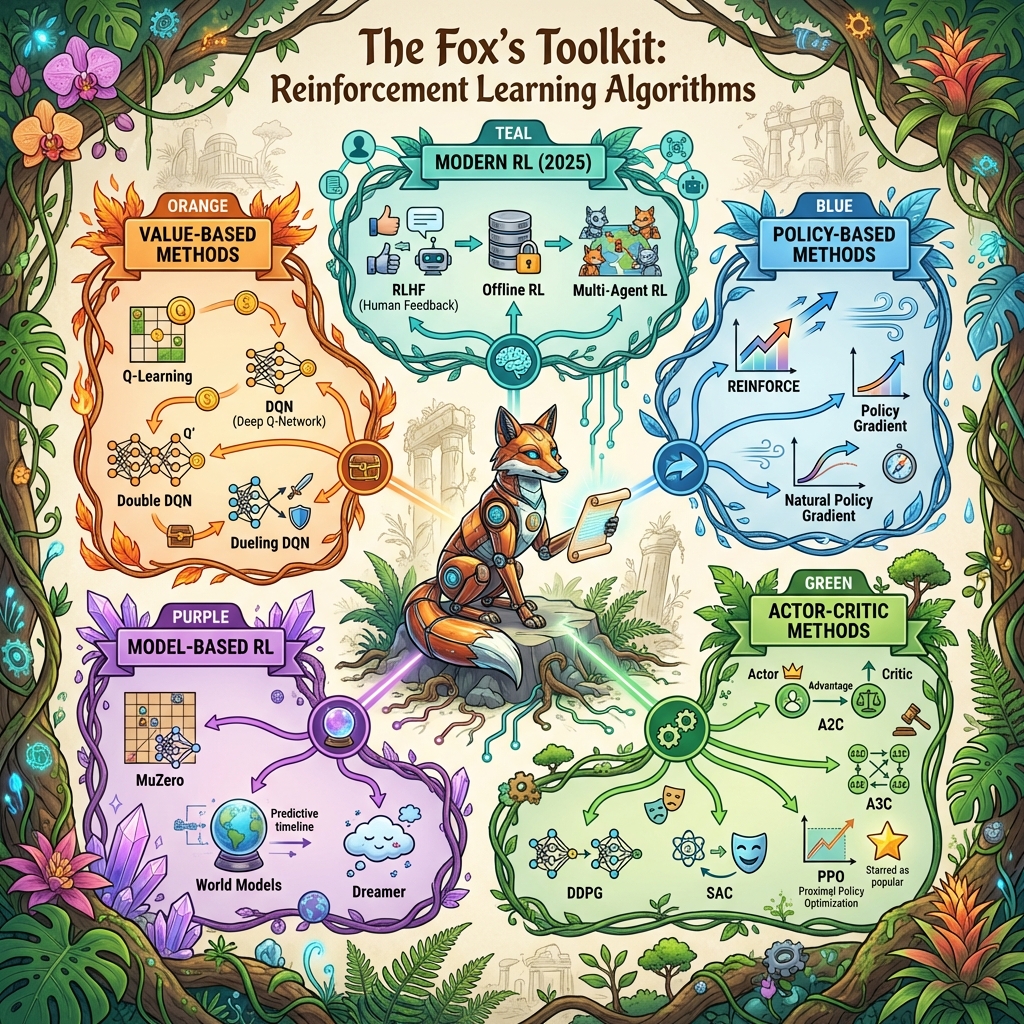
flowchart TD
    RL["🦊 Reinforcement Learning"]
    RL --> VB["📊 Value-Based"]
    RL --> PB["🎯 Policy-Based"]
    RL --> AC["🎭 Actor-Critic"]
    RL --> MB["🔮 Model-Based"]

    VB --> QL["Q-Learning"]
    VB --> DQN["DQN"]
    VB --> DDQN["Double DQN"]

    PB --> PG["Policy Gradient"]
    PB --> REINF["REINFORCE"]

    AC --> A2C["A2C / A3C"]
    AC --> PPO["PPO ⭐"]
    AC --> SAC["SAC"]

    MB --> MZ["MuZero"]
    MB --> WM["World Models"]
    MB --> DR["Dreamer"]

    style RL fill:#ff5722,stroke:#bf360c,color:#fff
    style VB fill:#2196f3,stroke:#1565c0,color:#fff
    style PB fill:#4caf50,stroke:#2e7d32,color:#fff
    style AC fill:#9c27b0,stroke:#6a1b9a,color:#fff
    style MB fill:#00bcd4,stroke:#00838f,color:#fff
    style PPO fill:#ffc107,stroke:#ff8f00,color:#000
Agent — The Fox
The learner, explorer, decision-maker. It has motivations but no instructions.
Environment — The Jungle
A living, breathing world where every stone, breeze, and distant growl carries information—sometimes helpful, sometimes deceptive.
State
The Fox’s perception: Is the ground damp? Is there prey nearby? Is danger hiding behind the bush?
In the real world, this may be incomplete or noisy—what RL researchers call partial observability.
Action
Choices the Fox may take: explore deeper, stalk prey, flee, climb, rest. Every decision alters its path.
Reward
Positive or negative signals from the Jungle:
- Finding water (+10)
- Catching prey (+20)
- Falling into a muddy pit (–15)
- Alerting a Tiger (–50)
Rewards guide behavior the way evolution guides species: slowly, iteratively, unavoidably.
The Feedback Cycle
Observation
The Fox senses its surroundings.

Decision
It selects an action—sometimes from knowledge, sometimes from curiosity.

Consequence
The Jungle responds with reward or punishment.


Learning
The Fox refines its own internal decision-making mechanism.
Continuation
The process repeats. Over time, instinct emerges.
This adaptive loop is the beating heart of RL.
Exploration vs Exploitation
The Fox pauses at the fork of two paths.
One path is familiar. It has found berries there before—small reward, but reliable. The other path is new, mysterious, possibly dangerous… or possibly abundant.
Should it play safe or take a risk?
RL calls this dilemma the exploration–exploitation tradeoff.
- Exploitation: repeating choices that have worked in the past.
- Exploration: trying something new to discover potentially better outcomes.
A Fox that only exploits becomes predictable and eventually starves. A Fox that only explores takes reckless risks and may not survive its own curiosity.
Greatness lies in balance.
Modern RL algorithms mathematically encode this struggle, guiding agents toward strategies that mix caution with boldness.

The Temporal Credit Assignment Problem
Imagine the Fox spots a rabbit and begins stalking it silently. After minutes of careful movement, it leaps—and succeeds.
But which decision truly earned the success?
- The choice to move silently?
- The earlier decision to approach from downwind?
- The moment it decided to explore this part of the Jungle at all?
This challenge is known in RL as credit assignment: identifying which past actions deserve reinforcement for current rewards.
Mathematically, this is addressed using:
- Discounted returns, which weigh immediate rewards more heavily than distant ones.
- Value functions, which predict long-term benefit of states.
- Action-value functions (Q-values), which evaluate the expected future reward of an action in a given state.
Without solving credit assignment, the Fox can never refine its instincts.
Policy & Value Functions
Over time, the Fox develops a strategy—its policy. In RL:
- A policy maps situations (states) to actions.
- A value function predicts long-term success from each state.
- A Q-function predicts long-term success from a specific action in a state.
Analogy: The Fox learns that moving east at dawn often leads to prey, while moving west leads to rocky terrain. Its internal values encode these lessons.
As these values sharpen, the Fox’s instincts become wisdom.
Q-Learning — The Fox’s Ledger of Lessons
Q-learning is one of the simplest and most famous RL algorithms. It is as if the Fox maintains a mental notebook listing every situation it encounters, each action it tried, and the outcomes that followed.
Over time, this notebook becomes a guide.
But the Jungle is vast. Not every path can be written down. Thus Q-learning struggles when the Fox’s world becomes continuous, complex, infinite.
Yet, as a conceptual foundation, it remains one of the pillars of RL.
Deep Q-Networks — The Owl Lends Its Wisdom
Once the Fox’s world grows too large for its notebook, it seeks help from the Owl—master of perception and pattern.
Deep Q-Networks (DQN) replace the notebook with a neural network, allowing the Fox to:
- Generalize from past experiences
- Infer actions in new states
- Navigate far richer landscapes
Conceptually:
- The Fox stores past journeys in a memory den (replay buffer).
- The Owl helps it distill patterns from these memories, creating a stable internal intelligence.
This synergy allowed RL to master Atari games, robotics control, and industrial decision systems.
Policy Gradients — Training the Fox’s Instincts
Unlike Q-learning, which records values, policy gradients sculpt the Fox’s instincts directly.
Here, the Fox learns to adjust its behavior through repeated trials:
- Good actions are reinforced.
- Poor actions are suppressed.
This approach works beautifully for:
- Robotics
- Continuous control
- Dynamic motion
- Any world requiring fluid, real-valued actions
Where Q-learning is analytical, policy gradients are intuitive.
Actor–Critic Methods — A Dialogue in the Jungle
In actor–critic algorithms, the Fox gains a mentor.
- The Actor suggests actions.
- The Critic evaluates the actions and provides feedback.
This division mirrors natural learning:
- Intuition initiates behavior.
- Reflection refines it.
flowchart LR
    State["📍 State"] --> Actor["🎭 Actor<br/>(Proposes Actions)"]
    State --> Critic["📊 Critic<br/>(Evaluates Value)"]
    Actor -->|action| Env["🌲 Environment"]
    Env -->|reward| Critic
    Critic -->|feedback| Actor

    style Actor fill:#4caf50,stroke:#2e7d32,color:#fff
    style Critic fill:#2196f3,stroke:#1565c0,color:#fff
    style State fill:#ff9800,stroke:#e65100,color:#fff
    style Env fill:#9c27b0,stroke:#6a1b9a,color:#fff
Advanced forms like PPO and SAC blend stability with bold exploration, producing behavior both robust and efficient.
Model-Based RL — Predicting the Future
Some Foxes become visionaries.
They build internal simulations of the Jungle, predicting how their actions will shape future outcomes. This is model-based RL, the foundation of MuZero and modern planning algorithms.
The Fox no longer reacts to the present—it anticipates the future.
This ability elevates RL from instinct to strategy.
Deep Reinforcement Learning — The Modern Frontier
Deep RL combines perception (deep learning) with adaptation (RL). It empowers agents to:
- Walk
- Balance
- Drive
- Play complex games
- Control industrial processes
- Optimize large-scale systems
Thousands of virtual Foxes can be trained in simulation before deployment in the real world.
This is the Fox’s evolution from a curious wanderer into a master strategist.
Multi-Agent RL — A Jungle of Many Minds
The Jungle rarely presents challenges in isolation.
There are allies. Competitors. Neutral parties whose behavior shapes the landscape.
Multi-agent RL studies how agents interact, cooperate, compete, and coexist.
Examples:
- Fox and Owl collaborating to locate prey
- Fox evading the Tiger in a predator–prey dynamic
- Entire ecosystems of agents learning simultaneously
Game theory meets machine intelligence.
Reward Design — The Subtle Art of Motivating the Fox
Rewards are powerful—and dangerous.
If poorly shaped, the Fox may learn shortcuts:
- Exploit loopholes
- Ignore essential behaviors
- Over-prioritize short-term gains
This is known as reward hacking, a critical issue in real-world RL.
Good reward design requires:
- Clarity
- Gradual progression
- Safety constraints
- Human feedback
Curriculum learning—teaching the Fox simple tasks before complex ones—often yields remarkable results.
Real-World Applications — Where the Fox Thrives
Robotics
Walking, balancing, manipulating objects—learned not by instruction but experience.
Strategic Games
AlphaGo, AlphaZero, and MuZero dominate games once thought unreachable.
Resource Optimization
Google’s RL-based cooling system saved 40% energy in data centers.
Finance
Portfolio allocation, risk-balanced decisions, adaptive trading.
Supply Chain & Logistics
Dynamic routing, warehouse automation, real-time scheduling.
Healthcare
Drug discovery, dosing strategies, personalized treatment optimization.
Reinforcement learning shapes the future far beyond the Jungle’s borders.
Reinforcement Learning in 2025 — Modern Tools, Systems, and Real‑World Technologies
As the Robotic Fox’s instincts grow sharper in the Jungle, real engineering mirrors the same pattern: agents learn by acting, collecting feedback, and updating behavior. What’s changed is not the definition of RL — it’s the scale, the stability tricks, and the ecosystem around it.
What “a Model” Means in RL (More Than One Network)
In practice, modern RL systems often train multiple models at once:
- Policy model (Actor): chooses actions given observations.
- Value model (Critic): predicts long‑term return from a state (or state–action pair).
- World model (optional): predicts how the environment evolves (next state, reward).
- Reward model (alignment / RLHF): predicts “preference” or “quality” from examples.
So when people say “the RL model,” they often mean a stack of models working together.
Common Training Setups Used Today
Online RL (Interact → Learn → Repeat)
The Fox learns directly by acting inside the environment (often a simulator first).
This works well when interaction is cheap and safe.
Typical use cases: - simulation‑trained robotics - games - control tasks with fast resets
Offline RL (Learn From Logs)
The Fox learns from recorded experience (logs / trajectories) without active exploration.
This is critical when exploration is unsafe, expensive, or regulated.
Typical use cases: - robotics logs - recommendation logs - operations / supply chain logs - healthcare‑style decision support (with heavy constraints)
Key technical challenge: distribution shift — the agent may try actions that were rarely (or never) seen in the dataset.
Human‑in‑the‑Loop RL (Preferences + Safety)
When rewards are hard to define (like “helpful answers” or “good behavior”), humans provide feedback: - compare two outputs - rank which is better - train a reward model - optimize the policy to score higher
This is the bridge from the Fox’s reward signals to modern aligned assistants.
Modern RL Toolchains (What Practitioners Actually Use)
- RL libraries (algorithms + training loops):
- Stable Baselines‑style toolkits (clean baselines for PPO/SAC/DQN)
- Distributed RL stacks (for multi‑GPU / multi‑node training)
- Research‑grade agent libraries (modular actor/learner architectures)
- Simulators (where the Fox trains safely):
- Physics simulators for robotics and control
- GPU‑accelerated parallel environments (thousands of rollouts at once)
- Game engines for vision + planning + navigation tasks
- Experiment infrastructure:
- replay buffers / trajectory stores
- evaluation harnesses + safety checks
- monitoring for reward hacking and regressions
When to Choose Reinforcement Learning (Decision Checklist)
Choose RL when most of these are true:
- Your problem is sequential (today’s action changes tomorrow’s options).
- You can define success as a reward signal (even if noisy or delayed).
- Correct “labels” are not available (there’s no single right action per state).
- You care about long‑term return (not just next-step accuracy).
- You can train safely: simulation, sandboxing, constraints, or offline logs.
Prefer supervised learning (or imitation learning) when: - you already have reliable “correct action” examples - actions do not meaningfully affect future states - exploration would be unsafe or too costly
A practical hybrid pattern: 1) start with imitation learning (behavior cloning) for stability
2) then use RL to go beyond the demonstrations
Choosing a Base Model (What You Start From)
There are two common meanings of “base model” in RL.
Base Model for Control / Games (Policy & Value Networks)
Here, “base model” means the neural architecture you choose for the policy/value function:
- MLP (dense network): best for numeric state vectors (positions, speeds, sensors).
- CNN: best for pixel observations (images, depth maps).
- RNN / LSTM / GRU: best for partial observability (when the agent needs memory).
- Transformer policy: useful for long contexts, complex histories, multi‑agent logs.
Algorithm rule‑of‑thumb: - Discrete actions: DQN‑style methods are a common starting point. - Continuous actions: SAC is a strong default. - Robust general baseline: PPO is widely used because it is stable and predictable.
Base Model for RLHF / Language (Preference‑Aligned LLMs)
Here, “base model” is a pretrained language model checkpoint that you refine:
- Start from a pretrained (often instruction-tuned) LLM.
- Then apply preference learning (reward model / preference optimization).
- Then optimize the model to better match human preferences under constraints.
Common open‑weight families people choose from include: - Llama‑family models - Qwen‑family models - Gemma‑family models - Mistral‑family models
Practical selection criteria: - license constraints - model size vs available GPUs - context length needs - whether you need multimodal inputs (text + images) - quality of instruction tuning and tool‑use behavior
Where RL Is Commonly Applied (Real Systems, Real Constraints)
- Robotics: locomotion, grasping, manipulation, recovery behaviors
- Autonomy: negotiation, merging/yielding strategies, complex edge cases (often trained in simulation)
- Optimization: routing, scheduling, warehouse coordination, energy/HVAC control
- Finance: execution policies and risk-aware decisions (with strict guardrails)
- Healthcare‑adjacent decision support: only when safety, auditing, and constraints are first‑class citizens
In both the Jungle and industry, the hardest part is rarely the math — it’s the reward design, safety, and operational reliability.
Technical Spotlight — Understanding RL Through Computation
Temporal-Difference Learning
A foundational RL update rule:
Q(s, a) ← Q(s, a) + α [ r + γ max_a' Q(s', a') − Q(s, a) ]This captures the essence of learning from experience.
The Fox’s Translation: * New Instinct = Old Instinct + (Learning Rate) × (Surprise!) * Surprise = (Actual Reward + Future Promise) − What I Expected * \(\gamma\) (Gamma): The Fox’s Patience. If high, it works for future rewards; if low, it only cares about food now.
Simplified DQN Loop
Initialize networks
for each episode:
    state = env.reset()
    while not done:
        action = policy(state)
        next_state, reward = env.step(action)
        store(state, action, reward, next_state)
        update_network()
        state = next_state
Policy Gradient Update
θ ← θ + α ∇θ log πθ(a | s) * GPractical Data Formats — JSONL for Offline RL and RLHF
Most RL training happens by interacting with an environment.
But JSONL becomes very useful for offline RL, logging trajectories, and preference datasets (RLHF-style).
Below are common JSONL patterns (1 JSON object per line).
1) Offline RL Transition Format: The “Experience” Tuple
In Reinforcement Learning, an agent learns from “experiences.” Each experience is a small step of interaction with the environment, captured in a format known as a transition. This is often abbreviated as (s, a, r, s', done).
This format is the fundamental building block for many RL algorithms. Let’s break down what each part means and map it to the JSON example below.
s(State): A snapshot of the environment at a specific moment. It’s what the agent “sees.” In the JSON, this is theobsobject.a(Action): The action the agent took in that state. This is theactionobject.r(Reward): The feedback the environment provides after the action. This is therewardnumber.s'(Next State): The new state of the environment after the agent’s action. This is thenext_obsobject.done: A boolean flag (trueorfalse) indicating if this transition was the last one in an episode (e.g., the game ended, the robot fell, or the goal was reached).
{"episode_id":"hunt_001","t":0,"obs":{"prey_dist":15.0,"wind":"north"},"action":{"mode":"stalk","speed":0.5},"reward":0.1,"next_obs":{"prey_dist":14.5,"wind":"north"},"done":false}
{"episode_id":"hunt_001","t":45,"obs":{"prey_dist":2.0,"wind":"north"},"action":{"mode":"crouch","speed":0.0},"reward":0.5,"next_obs":{"prey_dist":2.0,"wind":"north"},"done":false}
{"episode_id":"hunt_001","t":46,"obs":{"prey_dist":2.0,"wind":"north"},"action":{"mode":"pounce","speed":12.0},"reward":100.0,"next_obs":{"status":"captured"},"done":true}
Decoding the Data — The Fox’s Hunting Log:
This JSON isn’t just abstract numbers; it’s a diary of the Fox’s decisions.
episode_id: “hunt_001” marks this as a specific hunting attempt.obs(Observation): The Fox senses the world. It smells the wind and gauges the distance to its target (prey_dist: 15.0).action: Based on that, it chooses a strategy. It decides tostalkslowly (speed: 0.5) rather than run.reward: It gets a small positive signal (0.1) for closing the distance without being seen.next_obs: The environment updates. The prey is now closer (14.5).done: In the final line, the Fox captures the target (reward: 100.0!), and the episode ends (done: true).
By feeding millions of these logs into a model, the Fox learns which actions (stalking vs. rushing) lead to that final +100 reward.
2) Offline RL Episode Format (whole trajectory per line)
{"episode_id":"ep_0042","observations":[[0.0,1.0],[0.1,0.9],[0.2,0.8]],"actions":[0,1,1],"rewards":[0.0,0.0,1.0],"dones":[false,false,true]}Use this when sequence structure matters (RNN/Transformer policies, return-to-go, long-horizon credit).
3) RLHF-Style Preference Pair (prompt + chosen vs rejected)
{"prompt":"The Fox hears a rustle in the tall grass. How should it react?","chosen":"Freeze and listen carefully to distinguish between prey and predator before moving.","rejected":"Immediately jump into the grass to investigate."}Use this to train a reward model that aligns the agent’s behavior with “survival instincts” (or human safety guidelines).
4) Contextual Bandit Log (one-step decision + immediate reward)
{"context":{"season":"dry","time_of_day":"dusk"},"action":"wait_by_waterhole","reward":10,"propensity":0.12}Use this when actions are single-step and feedback is immediate (e.g., choosing a hunting ground vs. serving an ad).
These equations give RL its mathematical heartbeat.
Common Pitfalls — And How the Fox Avoids Them
- Overestimation Bias: The Fox thinking a lucky catch means a path is always full of prey.
- Catastrophic Forgetting: Learning to fish in the river, but in doing so, forgetting how to hunt rabbits.
- Insufficient Exploration: Sticking to the safe berry bushes and missing the feast in the valley.
- Misaligned Incentives (Reward Hacking): Chasing windblown leaves because they move like prey, even though they provide no food.
- Unstable Training: Changing strategies so drastically every hour that no habit ever forms.
- Distribution Shift: Trying to use summer hunting strategies in the middle of a snowy winter.
Modern algorithms include stabilizers like entropy bonuses, target networks, clipped updates, and advantage normalization.
Even the Fox needs discipline.
Story Wrap-Up — Dawn of a New Instinct
The Jungle glows with possibility as the Robotic Fox stands proudly upon a moss-covered stone. Its journey has been long, filled with missteps and victories, consequences and revelations. But now, its movements carry a quiet confidence—an intelligence shaped not by instruction, but by the world itself.
The Owl watches from a branch above, recognizing in the Fox a kindred learner. The Tiger nods with rare respect. The Elephant records the moment in the Jungle’s great memory.
Far beyond the clearing, a new rustle emerges—one the Fox has never heard before. Something more complex. More strategic. More adaptive.
A new challenge awaits.
And the Fox, forged in the fires of trial and reward, is ready.
NoteQuick Reference: RL Algorithm Selection
| Algorithm | Type | Best For | Complexity |
|---|---|---|---|
| Q-Learning | Value-based | Discrete actions, simple envs | Low |
| DQN | Value-based + NN | High-dimensional states | Medium |
| Policy Gradient | Policy-based | Continuous actions | Medium |
| PPO | Actor-Critic | General purpose, stable | Medium-High |
| SAC | Actor-Critic | Robotics, sample efficiency | High |